 Laravel Development
 React Development
 Vue.js Development
 Angular Development
 Node.js Development
 Python Development
 NativePHP Development
 Flutter Development
 Electron Development
 iOS/Swift Development
 MongoDB Development
 MySQL Development
 PostgreSQL Development
 DigitalOcean Development
 AWS Development
 Azure Development
 Strapi Development
 WordPress Development
 Shopify Development
 ConnectShip Services
HIPAA Compliant Software Development Company: Healthcare Apps & Platforms

Web Mavens builds secure healthcare apps, web platforms, and AI solutions for clinics, digital health startups, and enterprise health systems.
- Why HIPAA Compliant Software Development Matters More Than Ever
- Key HIPAA Requirements for Software Development
- Step-by-Step: How to Develop HIPAA Compliant Software
- HIPAA Compliant Mobile App Development
- HIPAA Compliant AI Software Development
- Common Challenges in HIPAA Compliance
- Patient Communication Software and Other Use Cases
- Why Choose Custom HIPAA Compliant Software Development?
- ✓ HIPAA compliance must be built in from day one - retrofitting costs 5-10x more than building it right the first time.
- ✓ Every vendor handling PHI must sign a Business Associate Agreement (BAA) before any data is shared.
- ✓ Mobile apps require encrypted storage, remote wipe, and biometric authentication to be HIPAA compliant.
- ✓ AI in healthcare must use private, VPC-deployed models - public AI APIs like standard ChatGPT are not HIPAA compliant.
- ✓ Non-compliance penalties range from $100 to $50,000 per violation, with annual maximums of $1.5 million per category.
Our HIPAA Compliant Development Services
Custom healthcare web platforms with encrypted PHI handling, audit logging, RBAC, and BAA-ready architecture.
Learn More →Native iOS/Android apps with encrypted local storage, biometric auth, remote wipe, and screenshot prevention.
Learn More →Multi-tenant cloud architecture with tenant-level PHI isolation, VPC deployment, and subscription billing.
Learn More →RAG assistants, clinical decision support, and NLP-powered charting with PHI-safe private model pipelines.
Learn More →In today's digital healthcare landscape, HIPAA compliant software development is no longer optional - it's essential. Whether you're building patient communication software, a telehealth platform, custom EHR integration, or advanced AI solutions, failing to meet HIPAA standards can result in massive fines, data breaches, and permanent loss of trust.
This complete guide covers everything you need to know about HIPAA compliant app development, how to make an app HIPAA compliant, HIPAA compliant mobile app development, and why HIPAA custom software development is the smartest choice for organizations that want secure, scalable, and future-ready healthcare solutions.
Why HIPAA Compliant Software Development Matters More Than Ever
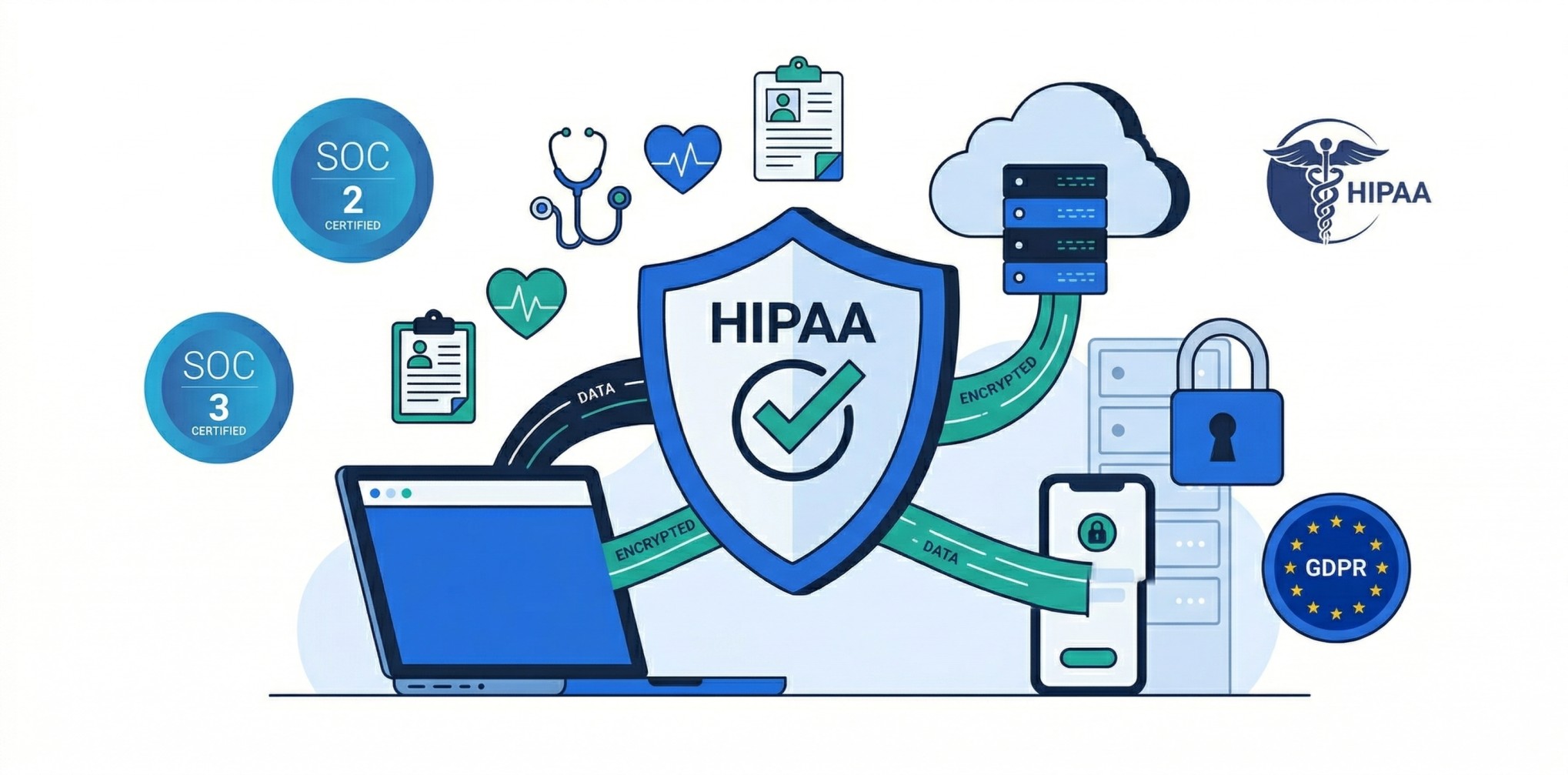
The Health Insurance Portability and Accountability Act (HIPAA) sets strict national standards for protecting Protected Health Information (PHI). Any software that creates, receives, maintains, or transmits electronic PHI (ePHI) must fully comply with the HIPAA Privacy Rule, Security Rule, Breach Notification Rule, and Omnibus Rule.
Non-compliance penalties can reach millions of dollars. Beyond fines, data breaches destroy patient trust and damage your reputation. For healthcare providers, clinics, digital health startups, and enterprises, building HIPAA compliance for software development from day one prevents expensive retrofits and creates a trustworthy product.
Custom development is particularly valuable here. Ready-made tools often cannot meet unique workflow needs. HIPAA custom software development allows you to build exactly what your users need while embedding compliance into every layer of the application.
"The most expensive compliance decision a healthcare startup can make is treating HIPAA as a checkbox at the end of development. When security architecture is an afterthought, you're not just risking fines - you're rebuilding from the ground up."
- Web Mavens Engineering Team, 25+ years delivering compliance-ready platforms
Key HIPAA Security Rule Requirements for Software Development
Understanding HIPAA security rule requirements is the foundation of any compliant build. HIPAA's Security Rule requires three categories of safeguards:
| Safeguard Type | What It Covers | Examples |
|---|---|---|
| Administrative | Policies and procedures | Risk assessments, workforce training, incident response plans |
| Physical | Facility and device protections | Controls to protect facilities, devices, and workstations |
| Technical | Technology-based protections | Access controls, audit logs, encryption, authentication |
Critical technical requirements include:
- Strong encryption at rest and in transit (AES-256 standard)
- Role-based access control (RBAC) and multi-factor authentication (MFA)
- Comprehensive audit logging (retained for minimum 6 years)
- Automatic logoff and session timeouts
- Secure data transmission using TLS 1.2 or higher
- HIPAA compliant database configuration with encrypted storage, access controls, and backup retention policies
Any developer or vendor who handles PHI must sign a Business Associate Agreement (BAA).
Building a Compliance-Ready Healthcare Platform?
SOC 2 and HIPAA are built into our development process from sprint one.
Step-by-Step: How We Develop HIPAA Compliant Software
Whether you're building from scratch or retrofitting an existing application, here's the structured, repeatable process our team follows to deliver HIPAA compliant software on every engagement:
- Conduct a Thorough Risk Assessment - Map all PHI data flows, identify threats and vulnerabilities, and document everything.
- Design with Compliance in Mind (Privacy by Design) - Choose HIPAA compliant cloud hosting (AWS, Azure, or GCP with a signed BAA), implement least-privilege access, and separate PHI from non-sensitive data.
- Implement Technical Safeguards - Add encryption, RBAC, MFA, audit logging, and integrity controls from the beginning.
- Establish Administrative and Physical Controls - Create policies, conduct regular staff training, and set up disaster recovery and backup procedures.
- Sign BAAs with All Vendors - Every third-party tool or subcontractor touching PHI needs a BAA.
- Test Rigorously - Perform penetration testing, vulnerability scanning, and compliance audits before launch.
- Monitor and Maintain Continuously - Conduct regular risk assessments and stay updated with evolving threats and regulations.
HIPAA Compliant Mobile App Development: Special Considerations
HIPAA compliant mobile app development adds extra complexity due to the portable nature of devices. You must implement:
- Encrypted local storage
- Remote wipe capabilities
- Strong biometric + PIN authentication
- Prevention of data leakage via screenshots or clipboard
- Secure APIs and end-to-end encryption
Testing on real devices across multiple OS versions is mandatory.
Need Laravel-Certified Developers for Your Healthcare App?
Our team holds official Laravel Partner status with SOC 2 and HIPAA compliance built in.
HIPAA Compliant AI Software Development
Artificial Intelligence is rapidly transforming healthcare, making HIPAA compliant AI software one of the fastest-growing demands in the industry.
HIPAA compliant generative AI and AI assistants can power clinical documentation, patient communication, symptom checkers, and predictive analytics - but they require strict controls.
Key Challenges
- Risk of PHI leakage through training data or model outputs
- Difficulty in auditing AI decision-making
- Compliance issues with public AI APIs (like standard ChatGPT)
Best Practices for Building HIPAA Compliant AI Solutions
- Use private, on-premise, or VPC-deployed AI models instead of public services
- Implement strict data isolation so PHI never reaches non-BAA vendors
- Apply full encryption, detailed audit logging for every AI interaction, and human oversight
- Use Retrieval-Augmented Generation (RAG) with vetted, de-identified data sources
- Perform dedicated AI risk assessments and regular penetration testing
Use cases include HIPAA compliant AI assistants for secure patient messaging, automated note generation, and intelligent triage systems. Organizations building these solutions should partner with developers experienced in both advanced AI and healthcare compliance.
"We've seen teams deploy AI chatbots in healthcare without realizing their API calls were sending PHI to servers without a BAA. The technical risk is real, but it's entirely avoidable with the right architecture decisions made upfront."
- Web Mavens Technical Lead, SOC 2 & HIPAA certified development
Common Challenges in HIPAA Compliance (and How to Overcome Them)
| Challenge | Impact | Solution |
|---|---|---|
| Adding compliance after development | 5-10x more expensive | Start with a secure development lifecycle |
| Managing multiple vendors | Compliance gaps | Require BAAs from everyone |
| Evolving threats and AI risks | Ongoing vulnerability | Schedule annual risk assessments and continuous monitoring |
| High cost of HIPAA compliance | Budget overruns | Work with experienced HIPAA compliant software companies that already have compliant infrastructure |
Patient Communication Software and Other Use Cases
Secure patient portals, HIPAA compliant messaging apps, telehealth platforms, and appointment systems are among the most requested HIPAA compliant software development projects. Custom solutions allow perfect integration with your existing systems while delivering excellent user experience.
Web Mavens has experience building digital health platforms with encrypted patient messaging, telehealth integration, and automated appointment scheduling - all architected to pass SOC 2 and HIPAA audits on the first review.
Why Choose Custom HIPAA Compliant Software Development?
Custom development gives you full control, better integration, and future scalability. When evaluating HIPAA compliant software companies, look for teams that bring pre-built compliant components, proven processes, and deep expertise - significantly reducing your risk and time-to-market.
Custom vs Off-the-Shelf HIPAA Software: A Direct Comparison
| Criteria | Custom HIPAA Software | Off-the-Shelf HIPAA Software |
|---|---|---|
| Compliance control | Full control over every safeguard | Limited to vendor's implementation |
| Workflow fit | Built around your exact processes | You adapt to the tool's workflow |
| Integration | Deep integration with existing EHR, billing, CRM | Limited API/connector options |
| Scalability | Scales with your growth, no user/feature caps | Pricing tiers, feature locks |
| Data ownership | 100% yours, hosted where you choose | Vendor-hosted, vendor-controlled |
| Audit readiness | Custom audit trails built to your requirements | Generic logging, may not meet auditor needs |
| Time to launch | 3-12 months depending on scope | Days to weeks (but customization takes months) |
| Long-term cost | Higher upfront, lower ongoing (no per-seat fees) | Lower upfront, higher ongoing (subscription + add-ons) |
| AI/ML capability | Full flexibility to deploy private AI models | Limited or no AI integration |
| Best for | Unique workflows, regulated industries, scale | Standard needs, small teams, fast start |
Whether you need a secure patient communication platform, HIPAA compliant mobile app, advanced HIPAA compliant AI software, or a compliant SaaS platform, building it the right way from day one is critical. This is especially true in high-stakes verticals like FinTech where healthcare payment data adds another layer of regulatory complexity.
Our team specializes in HIPAA custom software development and can help you create secure, compliant, and innovative healthcare solutions.
Considering Staff Augmentation for Your Healthcare Project?
Our developers integrate into your team within 48 hours with HIPAA compliance built in.